Why Japan industrialized before China
Money & Macro · 2026-07-24 · 33 分鐘
https://www.youtube.com/watch?v=PZd5tcGdQqc影片總結
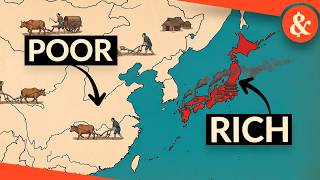
Meiji Japan paired mass education, state-led industry, zaibatsu financing, and export controls to industrialize without Egypt’s foreign-debt trap.
After unequal treaties exposed Japan to Western pressure, the Meiji government pursued “enrich the country, strengthen the military.” It expanded schooling and technical translation, built railways and telegraphs, and dismantled feudal barriers; attendance rose from about 45% in 1870 to over 98% by 1901. State factories and mines coordinated industries that private investors would not build alone, then Matsukata’s reforms curbed inflation and transferred many enterprises to competitive zaibatsu such as Mitsui and Sumitomo. This system helped Japan defeat China in 1895 and Russia in 1905, ending the unequal treaties. Sakichi Toyoda’s loom business illustrates the model: state infrastructure and Mitsui backing helped it survive, and in 1929 Britain’s Platt Brothers bought its automatic-loom patent for £100,000. The video also explains cash land taxes, targeted credit, export support, a weak yen, and low tariffs as ways to fund growth while conserving foreign reserves. It closes on the human cost—long shifts, exploited women, and suppressed unions—and argues that these pressures later fed political instability and militarism.
章節
- 0:00Intro: Japan’s 5% tariff cap and the five building blocks of the Meiji miracle
- 3:24Building block 1: Meiji education, technical translations, and infrastructure enabled Sakichi Toyoda
- 9:25Building block 2: Japan’s class reform and 1885 patent law contrasted with Argentina’s agrarian growth
- 12:18Building block 3, part 1: Okubo’s industrial big push, the Satsuma Rebellion, and Matsukata’s crackdown
- 16:42Building block 3, part 2: Zaibatsu backed Japan’s victories and Toyoda’s £100,000 loom patent sale
- 21:10Building block 4: Japan’s 3% cash land tax and targeted credit avoided Egypt’s foreign-debt trap
- 26:51Building block 5: Meiji export support, a weaker silver-linked yen, and labor exploitation
- 31:03Conclusion: The Meiji model’s influence and The Economist’s 35% offer
這是 Tier 1 公開摘要
每章重點、段落總結、心智圖由分享者控制是否公開。想看完整分析?自己提交一支。
同頻道的其他分析
 Economist reacts to podcast guests bashing economic scienceMoney & MacroJoeri argues economics is real social science, while debating Gary’s forecasts, Michael Saylor’s model critique, and Steve Keen’s education warning.
 Why Gen-Z cannot find a job anymoreMoney & MacroAI is squeezing entry-level hiring, while Trump’s tariffs and the end of COVID stimulus deepen the jobs slowdown.
 Why China's mineral monopoly can still be brokenMoney & MacroChina controls about 95% of rare-earth refining and magnet production, prompting a five-step plan for Western supply-chain independence.
 How scientists radically reduced US gun violence (no gun ban)Money & MacroPhiladelphia lot cleanups cut gun violence nearly 30%, while Chicago’s Becoming a Man program reduced violent arrests 45–50%.
 The 5 megatrends that will dominate 2026Money & MacroJuri forecasts China’s industrial rise, debt constraints, an AI bubble surviving 2026, and a 25% chance of a Taiwan blockade.
相關主題的分析
 【年度总结】一口气了解过去一年的全球经济|关税战新格局小Lin说特朗普關稅重塑貿易,印度成長 6.6% 領跑;美國押注 AI,日本通膨與中國內需成 2026 年變數。
 How the Last Queen of Egypt Lost EVERYTHINGNightshift – Kurzgesagt After DarkCleopatra funded Mark Antony’s wars, but Octavian’s victory at Actium ended her rule and made her Egypt’s final queen.
 The Ninjas Didn't ExistNightshift – Kurzgesagt After DarkIga’s samurai spies became Tokugawa castle detectives, while today’s ninja myths emerged largely from 20th-century films and fiction.
 Why Japan isn’t broke yetMoney & MacroJapan’s net government debt fell to 77% of GDP as foreign assets surged, but aging and inflation threaten its carry-trade strategy.
 How long can the US keep borrowing so much?Money & MacroU.S. interest payments now exceed military spending, and projected costs could overtake Medicare by 2029.