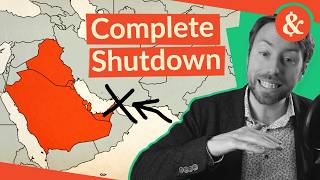
The Gulf economies are in BIG trouble
Money & Macro · 2026-04-03 · 26 min
https://www.youtube.com/watch?v=01V3IEn2MsYVideo summary
A Hormuz blockade could paralyze 62% of Qatar’s economy, yet Gulf wealth funds may sustain most states for years.
The video examines how war and a Strait of Hormuz blockade threaten Gulf economies built on oil, aviation, tourism and trade. Qatar could see 62% of its economy paralyzed, while Goldman Sachs estimates a 14% contraction in 2026 if the conflict ends by late April; Kuwait faces a similar forecast, versus 5% for the UAE and 3% for Saudi Arabia. A prolonged blockade would disrupt exports and raise food and medicine costs, but wealth funds and alternative pipelines provide buffers: Kuwait could last about 10 years, Qatar eight, the UAE 7.5, Iraq nearly two, and Bahrain only seven months. The gravest danger may be attacks on desalination plants, which supply 99% of Qatar’s drinking water, while mass immigrant departures could also hurt regional economies. Even an extreme war may not cause Gulf-wide financial collapse, but recovery, Dubai’s safe-haven status and Saudi megaprojects are at risk.
Chapters
- 0:00Introduction: Hormuz blockade puts 62% of Qatar’s economy at a standstill
- 4:00Scenario 1: Bahrain faces 41% paralysis while Iraq diverts oil via Turkey
- 7:00Scenario 2: Hormuz disruption threatens 95% of some Gulf export revenue
- 14:00Scenario 3: Kuwait’s $1 trillion fund could cover a decade of lost exports
- 20:29Scenario 3: Desalination attacks could evacuate Qatar as Gulf resilience is tested
What the full analysis includes
5 chapters · 26 key points · 5 section summaries · mind map
Preview of the first chapter · Introduction: Hormuz blockade puts 62% of Qatar’s economy at a standstill
The remaining 23 key points, section summaries and mind map are in the full analysis. Analyze this video to see everything →
This is a Tier 1 public summary
Whether the chapter key points, section summaries and mind map are public is up to the person who shared it. Want the full analysis?Submit one yourself.
More from this channel
 Why China's mineral monopoly can still be brokenMoney & MacroChina controls about 77% of rare-earth refining; the video proposes five steps to rebuild allied supply chains.
 The distorted economics of mass mediaMoney & MacroSequels dominate 2025’s top 20, but cheaper production and global markets have created a thriving creative long tail.
 Why the new world order will be worse than you thinkMoney & MacroTrump’s Greenland and Venezuela moves may reflect billionaire court politics as much as U.S. strategy, amid the order’s collapse.
 If the strait opens, what happens to the economy?Money & MacroA two-week US-Iran ceasefire reopened Hormuz, easing oil prices while leaving food, currency and peace risks unresolved.
 Who will pay for 100 million boomer pensions?Money & MacroAging threatens pensions worldwide: Chile’s early withdrawals crashed stocks and fueled inflation, while funded systems may not escape the demographic squeeze.
Related analyses
 How bad will the energy crisis get?Money & MacroYuri says a six-month Hormuz crisis is 80% likely, with oil reaching $150–$200 per barrel and energy costs surging worldwide.
 EP151 - NVIDIA 的 CUDA 護城河消失中,但老黃早已想到下一步?AI 輔助的個人化 mRNA 癌症療法來了!科技浪黃仁勳布局 5000 億美元 AI 工廠資產市場,莫德納個人化 mRNA 癌症療法三期試驗達標
 外資今年增資兩百億 但借錢卻愈來愈難?|#聽了財知道 EP376 #外資 #融資財訊外資券商今年增資逾 200 億元創新高,銀行流動性仍充足,借貸吃緊集中在非銀行業與中小企業。