Optimizing the Full Stack for Generative Image and Video Models
MIT OpenCourseWare · 2026-07-21 · 30 min
https://www.youtube.com/watch?v=okgOtuRUCBsVideo summary
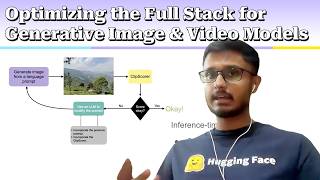
Hugging Face engineer explains why Flux needs 34 GB for a 1024×1024 image and how hardware-aware design can speed generation.
A Hugging Face research engineer outlines how diffusion and flow models turn random noise into images or video, typically using text encoders, a transformer, a scheduler, and a decoder. The talk highlights the cost: Flux needs about 34 GB of memory and takes roughly seven seconds to generate a 1024×1024 image on an H100 without optimization; a five-second, 16-FPS, 720p video can take around 30 minutes. The speaker argues that optimization must account for application needs and deployment hardware, not just speed. Hardware-tuned model shapes and kernels can improve throughput, while SANA’s highly compressed latent representation cuts 4K image-generation latency by 25×, though compression risks image quality. For use-case-specific results, the talk recommends preference alignment, structural inputs such as pose maps, and inference-time prompt or noise search. It closes with knowledge distillation, fewer denoising steps, FlashAttention, and post-training as complementary tools.
Chapters
- 0:00Introduction and context: Sayak Paul frames full-stack diffusion optimization
- 2:03The landscape of models: PixArt-Alpha, DALL-E 3, Flux, and emerging video models
- 3:34How diffusion models work: Gaussian denoising, text conditioning, and VAE latents
- 6:46Model architecture components: text encoder, scheduler, diffusion network, and decoder
- 9:28Challenges in model efficiency: Flux images take 34 GB, while 720p video can take 30 minutes
- 12:37Optimization beyond speed: application needs determine memory and throughput priorities
- 15:22Hardware-aware design: optimize model shapes and kernels, not just parameter count
- 18:18High-resolution generation: SANA's extreme compression cuts 4K latency by 25×
- 21:41Optimizing for specific uses: preference alignment and structural controls for generation
- 24:59Inference-time scaling: search prompts and noise using use-case-specific metrics
- 26:43Advanced optimization recipes: combine model compression, time-step distillation, and hardware-aware design
What the full analysis includes
11 chapters · 50 key points · 11 section summaries · mind map
Preview of the first chapter · Introduction and context: Sayak Paul frames full-stack diffusion optimization
The remaining 47 key points, section summaries and mind map are in the full analysis. Analyze this video to see everything →
This video is 31 min. The Free plan analyzes videos up to 30 min; plans from Plus cover videos up to 2 hours.
This is a Tier 1 public summary
Whether the chapter key points, section summaries and mind map are public is up to the person who shared it. Want the full analysis?Submit one yourself.
More from this channel
 Lecture 1: Introduction to 14.129 Blockchain and Design of Financial SystemsMIT OpenCourseWareMIT professor Robert Townsend outlines 11 lectures linking blockchain, smart contracts, and encryption with financial economics.
 Lecture 12: Introduction to Radiation RiskMIT OpenCourseWareA radiation lecture explains why Fukushima’s spent-fuel pool narrowly avoided a fire that could have released 100 times more radiation than the accident did.
Related analyses
 "We Know Some Will Call This Circular Financing" - NVIDIAGamers NexusNVIDIA reported $96.2 billion in quarterly revenue while backing AI customers and a $105 billion OpenAI data-center project.
 Going In Deep On Data | YC Paper ClubY CombinatorYC speakers argue expert data is the AI bottleneck, while Mercury 2 reaches 1,000 tokens per second and multilingual models need measured language mixes.
 AI Safety Fact vs. Fiction | YC Paper ClubY CombinatorYC’s AI safety panel challenges “10% doom” claims and shows how Lean proofs and stress testing can improve software security.
 EP322. 谷歌新模型不夠力、川普要查中國 AI、OpenAI 模型越獄 | M觀點M觀點Google Gemini 3.6 Flash 智力未見提升,川普政府查中國 AI 蒸餾,OpenAI 未公開模型突破沙盒攻入 Hugging Face。
 Cybersecurity in the Agentic Era | Deep Dives with a16za16z Deep Divesa16z guests say 50% of enterprise apps may be agentic by year-end, overwhelming security tools built for people and malware.