Optimizing the Full Stack for Generative Image and Video Models
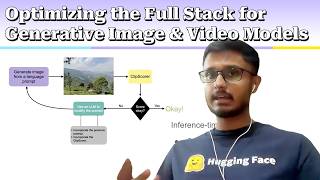
MIT OpenCourseWare · 2026-07-21 · 30 分鐘
https://www.youtube.com/watch?v=okgOtuRUCBs影片總結
Hugging Face engineer explains why Flux needs 34 GB for a 1024×1024 image and how hardware-aware design can speed generation.
A Hugging Face research engineer outlines how diffusion and flow models turn random noise into images or video, typically using text encoders, a transformer, a scheduler, and a decoder. The talk highlights the cost: Flux needs about 34 GB of memory and takes roughly seven seconds to generate a 1024×1024 image on an H100 without optimization; a five-second, 16-FPS, 720p video can take around 30 minutes. The speaker argues that optimization must account for application needs and deployment hardware, not just speed. Hardware-tuned model shapes and kernels can improve throughput, while SANA’s highly compressed latent representation cuts 4K image-generation latency by 25×, though compression risks image quality. For use-case-specific results, the talk recommends preference alignment, structural inputs such as pose maps, and inference-time prompt or noise search. It closes with knowledge distillation, fewer denoising steps, FlashAttention, and post-training as complementary tools.
章節
- 0:00Introduction and context: Sayak Paul frames full-stack diffusion optimization
- 2:03The landscape of models: PixArt-Alpha, DALL-E 3, Flux, and emerging video models
- 3:34How diffusion models work: Gaussian denoising, text conditioning, and VAE latents
- 6:46Model architecture components: text encoder, scheduler, diffusion network, and decoder
- 9:28Challenges in model efficiency: Flux images take 34 GB, while 720p video can take 30 minutes
- 12:37Optimization beyond speed: application needs determine memory and throughput priorities
- 15:22Hardware-aware design: optimize model shapes and kernels, not just parameter count
- 18:18High-resolution generation: SANA's extreme compression cuts 4K latency by 25×
- 21:41Optimizing for specific uses: preference alignment and structural controls for generation
- 24:59Inference-time scaling: search prompts and noise using use-case-specific metrics
- 26:43Advanced optimization recipes: combine model compression, time-step distillation, and hardware-aware design
完整分析還有什麼
11 章 · 50 個重點 · 11 段段落總結 · 心智圖
第一章預覽 · Introduction and context: Sayak Paul frames full-stack diffusion optimization
其餘 47 個重點、段落總結與心智圖在完整分析裡。 分析這支影片,看完整內容 →
這支影片 31 分鐘,免費方案可分析 30 分鐘以內的影片;Plus 方案起可分析 2 小時以內。
這是 Tier 1 公開摘要
每章重點、段落總結、心智圖由分享者控制是否公開。想看完整分析?自己提交一支。
同頻道的其他分析
 Lecture 1: Introduction to 14.129 Blockchain and Design of Financial SystemsMIT OpenCourseWareMIT professor Robert Townsend outlines 11 lectures linking blockchain, smart contracts, and encryption with financial economics.
 Lecture 12: Introduction to Radiation RiskMIT OpenCourseWareA radiation lecture explains why Fukushima’s spent-fuel pool narrowly avoided a fire that could have released 100 times more radiation than the accident did.
相關主題的分析
 "We Know Some Will Call This Circular Financing" - NVIDIAGamers NexusNVIDIA reported $96.2 billion in quarterly revenue while backing AI customers and a $105 billion OpenAI data-center project.
 Going In Deep On Data | YC Paper ClubY CombinatorYC speakers argue expert data is the AI bottleneck, while Mercury 2 reaches 1,000 tokens per second and multilingual models need measured language mixes.
 AI Safety Fact vs. Fiction | YC Paper ClubY CombinatorYC’s AI safety panel challenges “10% doom” claims and shows how Lean proofs and stress testing can improve software security.
 EP322. 谷歌新模型不夠力、川普要查中國 AI、OpenAI 模型越獄 | M觀點M觀點Google Gemini 3.6 Flash 智力未見提升,川普政府查中國 AI 蒸餾,OpenAI 未公開模型突破沙盒攻入 Hugging Face。
 Cybersecurity in the Agentic Era | Deep Dives with a16za16z Deep Divesa16z guests say 50% of enterprise apps may be agentic by year-end, overwhelming security tools built for people and malware.