The Gulf economies are in BIG trouble
Money & Macro · 2026-04-03 · 26 min
https://www.youtube.com/watch?v=01V3IEn2MsYVideo summary
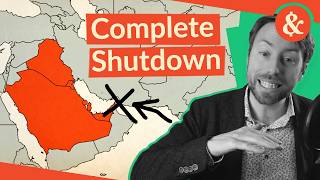
A Hormuz blockade could paralyze 62% of Qatar’s economy, yet Gulf states have years of financial buffers to endure a prolonged war.
The video assesses how war and a Strait of Hormuz blockade threaten Gulf economies built on oil, aviation, tourism and trade. Qatar is most exposed: with airspace and shipping disrupted, an estimated 62% of its economy is paralyzed; if the war ends in late April, Goldman Sachs forecasts a 14% contraction in 2026, matching Kuwait, versus 5% for the UAE and 3% for Saudi Arabia. Food and medicine imports are costlier and rerouted, but reserves and price controls have limited consumer-price shocks. In a prolonged conflict, export revenues could plunge, yet sovereign wealth funds and central-bank reserves offer substantial staying power: Kuwait could last about 10 years, Qatar eight, the UAE seven and a half, Iraq nearly two, while Bahrain has roughly seven months. The gravest threat is water: desalination supplies 99% of Qatar’s drinking water, and attacks could force evacuations. Even so, the Gulf’s financial buffers make total economic collapse less likely than a deep recession and lasting damage to Dubai’s safe-haven image and Saudi megaprojects.
Chapters
- 0:00Introduction: Hormuz Blockade Puts at Least 62% of Qatar’s Economy at Risk
- 4:00Scenario 1: Bahrain Faces 41% Disruption, While Iraq Diverts Oil Through Turkey
- 7:00Scenario 2: Qatar and Kuwait Could Shrink 14% as Hormuz Export Revenues Come Under Threat
- 14:00Scenario 3, Part 1: Wealth Buffers Could Keep Kuwait Going for Ten Years, but Bahrain Only Seven Months
- 20:29Scenario 3, Part 2: Desalination Attacks Could Force Evacuations as Gulf Resilience Faces Its Test
This is a Tier 1 public summary
Whether the chapter key points, section summaries and mind map are public is up to the person who shared it. Want the full analysis?Submit one yourself.
More from this channel
 Economist reacts to podcast guests bashing economic scienceMoney & MacroJoeri argues economics is real social science, while debating Gary’s forecasts, Michael Saylor’s model critique, and Steve Keen’s education warning.
 Why Gen-Z cannot find a job anymoreMoney & MacroAI is squeezing entry-level hiring, while Trump’s tariffs and the end of COVID stimulus deepen the jobs slowdown.
 Why China's mineral monopoly can still be brokenMoney & MacroChina controls about 95% of rare-earth refining and magnet production, prompting a five-step plan for Western supply-chain independence.
 How scientists radically reduced US gun violence (no gun ban)Money & MacroPhiladelphia lot cleanups cut gun violence nearly 30%, while Chicago’s Becoming a Man program reduced violent arrests 45–50%.
 The 5 megatrends that will dominate 2026Money & MacroJuri forecasts China’s industrial rise, debt constraints, an AI bubble surviving 2026, and a 25% chance of a Taiwan blockade.
Related analyses
 How bad will the energy crisis get?Money & MacroYuri sees an 80% chance of a six-month Hormuz crisis, with oil reaching $150–$200 per barrel.
 If the strait opens, what happens to the economy?Money & MacroA two-week US-Iran ceasefire reopened the Strait of Hormuz, but energy prices remain high and Israel could derail peace talks.
 The PetroDollar is a myth. The Iran war confirmed it.Money & MacroThe 1974 US-Saudi deal prioritized stable oil prices, not dollar-only sales; Gulf petrodollars remain too small to underpin dollar dominance.
 EP151 - NVIDIA 的 CUDA 護城河消失中,但老黃早已想到下一步?AI 輔助的個人化 mRNA 癌症療法來了!科技浪黃仁勳要把 NVIDIA AI Factory 變成投資資產,莫德納個人化 mRNA 療法試驗達標,癌症復發與死亡風險降 49%。
 How to lose $35 Billion Dollars Betting on AIColdFusionLeopold Aschenbrenner’s AI fund fell from $45 billion to $10 billion after 400% leverage magnified a two-sided bet gone wrong.