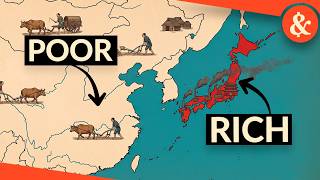
Why Japan industrialized before China
Money & Macro · 2026-07-24 · 33 分鐘
https://www.youtube.com/watch?v=PZd5tcGdQqc影片總結
Meiji Japan built an industrial powerhouse through education, state investment, zaibatsu, and export policies—without Egypt’s foreign-debt trap.
Japan’s Meiji leaders faced unequal treaties and the threat of colonization, then pursued rapid industrialization under the goal of enriching the country and strengthening its military. The government expanded schooling, translated technical knowledge into Japanese, built railways and telegraph lines, and helped inventors such as Sakichi Toyoda learn and scale new technologies. It dismantled feudal restrictions, protected patents, and coordinated investment in industries that private firms would not build alone. After costly state ventures and the Satsuma Rebellion fueled inflation, Matsukata Masayoshi cut waste and sold factories to competing zaibatsu such as Mitsui, while the state retained strategic roles. Japan financed imports through export earnings and targeted domestic credit rather than foreign borrowing, and supported exports through subsidies, procurement, and a weak yen. The account also stresses the costs: harsh factory labor and suppressed unions helped fuel later political instability.
章節
- 0:00Intro: Japan’s 1868 Meiji transformation and five building blocks
- 3:24Building block 1: Meiji schools, technical translations, and infrastructure enabled Sakichi Toyoda
- 9:25Building block 2: Meiji abolished feudal barriers and protected inventors with the 1885 patent law
- 12:18Building block 3: Okubo’s coordinated industry push, Satsuma costs, and 1878 assassination
- 16:42Building block 3: Matsukata’s zaibatsu system, Japan’s victories, and Toyoda’s £100,000 patent sale
- 21:10Building block 4: Japan’s 3% cash land tax and targeted credit amid tariff restrictions
- 26:51Building block 5: Silver-standard yen, state support, and exploited factory workers
- 31:03Conclusion: Japan’s mixed-economy model influenced Taiwan, Korea, and China
完整分析還有什麼
8 章 · 35 個重點 · 8 段段落總結 · 心智圖
第一章預覽 · Intro: Japan’s 1868 Meiji transformation and five building blocks
其餘 32 個重點、段落總結與心智圖在完整分析裡。 分析這支影片,看完整內容 →
這支影片 34 分鐘,免費方案可分析 30 分鐘以內的影片;Plus 方案起可分析 2 小時以內。
這是 Tier 1 公開摘要
每章重點、段落總結、心智圖由分享者控制是否公開。想看完整分析?自己提交一支。
同頻道的其他分析
 Why China's mineral monopoly can still be brokenMoney & MacroChina controls about 77% of rare-earth refining; the video proposes five steps to rebuild allied supply chains.
 The distorted economics of mass mediaMoney & MacroSequels dominate 2025’s top 20, but cheaper production and global markets have created a thriving creative long tail.
 Why the new world order will be worse than you thinkMoney & MacroTrump’s Greenland and Venezuela moves may reflect billionaire court politics as much as U.S. strategy, amid the order’s collapse.
 The Gulf economies are in BIG troubleMoney & MacroA Hormuz blockade could paralyze 62% of Qatar’s economy, yet Gulf wealth funds may sustain most states for years.
 If the strait opens, what happens to the economy?Money & MacroA two-week US-Iran ceasefire reopened Hormuz, easing oil prices while leaving food, currency and peace risks unresolved.
相關主題的分析
 "We Know Some Will Call This Circular Financing" - NVIDIAGamers NexusNVIDIA reported $96.2 billion in quarterly revenue while backing AI customers and a $105 billion OpenAI data-center project.
 The Ninjas Didn't ExistNightshift – Kurzgesagt After DarkIga’s shinobi began as spies and castle detectives; postwar films later invented the familiar black-clad ninja.
 The 5 megatrends that will dominate 2026Money & MacroJuri forecasts China’s industrial advance, debt crises, an unpopped AI bubble, and a 25% chance of a Taiwan blockade in 2026.
 Why Japan isn’t broke yetMoney & MacroJapan’s net debt fell from 118% to 77% of GDP as foreign investments and a weaker yen boosted its assets—but inflation threatens the strategy.