Inside OpenAI’s Breakthroughs in Mathematical Reasoning
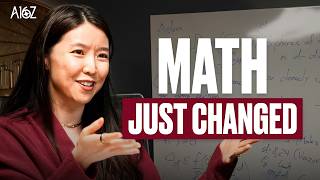
a16z · 2026-09-08 · 65 min
https://www.youtube.com/watch?v=1JvyLGd2SfsVideo summary
OpenAI mathematicians Mehtaab Sawhney and Mark Sellke explain Astra’s sphere-packing bound and non-sofic group proof.
a16z’s Lisha Li talks with OpenAI mathematicians Mehtaab Sawhney and Mark Sellke about how GPT-5 changed their view of AI mathematics. They say models can find relevant literature, choose promising approaches, backtrack, and persist through technical details that might make a human abandon an idea. Their examples include Astra’s sphere-packing result: it determines the asymptotic behavior of a linear-programming bound, improving understanding of high-dimensional packing, where exact answers are known in only five dimensions, including 8 and 24. Astra also improved bounds for spherical and binary codes, using representation theory and symmetry. The mathematicians then describe its proof that non-sofic groups exist—a roughly 15-page group-theory argument, far shorter and less technically sprawling than a related 250-page disproof of the Aldous–Lyons conjecture. They expect AI to speed up results while making human explanation, absorption, and connecting discoveries increasingly important; even exponential progress may leave problems such as P versus NP beyond reach.
Chapters
- 0:00From Practicing Mathematicians to OpenAI: Mark Sellke, Mehtaab Sawhney, and the IMO Gold Medal
- 2:43Why GPT-5 Was the Conversion Moment: A Five-Minute Search of Erdős Problems Found a Reference
- 4:21Beyond Search and Connections: Unit-Distance Proofs Show AI’s Persistence and Mathematical Judgment
- 9:51Reasoning Traces: Models Reconsider Failed Paths and Reassess Their Promise
- 11:44Why Math Papers Are a Poor Training Set for Real Mathematics: Motivation, Backtracking, and Reasoning Traces
- 16:20The Astra 10-Problem Set: Sphere Packing, Hexagonal Lattices, and the E8 and Leech Lattices
- 21:16The Astra 10-Problem Set: Astra Improves the Sphere-Packing LP Bound to About 2 to the Minus 0.61d
- 26:18Astra’s Sphere-Packing Bound: An Exact LP Result, Then Binary Codes
- 31:38Astra’s Representation-Theory Bounds for Spherical and Binary Codes
- 36:17Astra’s Task-Oriented Prompting: Asking It to Push Code Bounds Further
- 40:01Taste as Useful Judgment: Pruning Search and Stepping Back
- 43:42Astra’s Non-Sofic Group Result: Groups, Symmetry, and Finite Approximation
- 48:57Sofic Approximation: Integers Modulo n and the 15-Page Non-Sofic Proof
- 53:35Astra’s Short Group-Theory Proof: A Combinatorial Obstruction and Follow-Up
- 57:32How Should the Math Community Adopt AI? Models Summarize Proofs and Broaden Participation
- 1:00:01Empirical vs Theoretical Math & the Positive Vision: Shared Understanding, P vs. NP, and Faster Applied Math
This is a Tier 1 public summary
Whether the chapter key points, section summaries and mind map are public is up to the person who shared it. Want the full analysis?Submit one yourself.
More from this channel
 How Cursor Built One of AI’s Fastest-Growing Companiesa16zCursor bet on the human-model interface, grew rapidly without early sales hires, and later expanded through Graphite and founder acquisitions.
 Why Top Founders Are Racing Into AI Infrastructurea16za16z’s Machine Age Fund targets AI infrastructure as GPU supply is booked to 2028 and memory demand needs three years of capacity.
 Why AI Demand Is Outrunning Compute Supplya16zGavin Baker argues AI compute demand will outpace supply, with sub-one-year infrastructure paybacks and orbital data centers approaching.
 What Today’s Best Models Still Can’t Do in Matha16zDaniel Litt praises AI’s Erdős unit-distance result but warns that proofs alone cannot replace mathematical understanding or human curiosity.
 Inside Moderna’s Biggest mRNA Test Since COVIDa16zModerna and Merck’s personalized mRNA vaccine beat Keytruda alone in a Phase 3 melanoma trial, after 1,000 cancer-vaccine trials failed.
Related analyses
 LLM 之後:Thinking Machines 互動模型的誕生 | S2E57矽谷輕鬆談 Just Kidding TechThinking Machines 推出每 200 毫秒互動的多模態模型,Mira Murati 希望打造更自然的人機協作。
 Cybersecurity in the Agentic Era | Deep Dives with a16za16z Deep Divesa16z, Neo, and Cotool warn that AI agents are breaking traditional cybersecurity defenses as 50% of enterprise apps go agentic.
 OpenAI President on What it Means to Cross Into The Age of AGIa16zOpenAI’s Greg Brockman calls Astra AGI after 24-hour tasks and urges a billion-dollar cybersecurity push for frontline defenders.
 How Jev Turns AI Into Software That Gets Things Donea16zTypeSafe founder Diogo Almeida says Jev embeds probabilistic intelligence in software, aiming to automate work and make SaaS applications more capable.
 New Grad求職有多困難?矽谷大裁員、AI取代工程師恐慌下靠什麼進入OpenAI、Google、LinkedIn、Salesforce哈佛姐夢遊矽谷 AliceInSiliconWonderlandBerkeley New Grad 求職率約三成,四位來賓分享靠 GitHub 職缺、校友推薦與真人模擬面試進入 OpenAI、Google 等公司。