Why AI Can Write Code But Can’t Keep It Running (Yet)
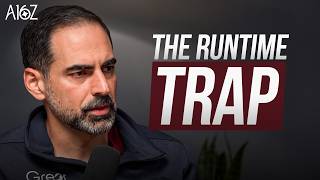
a16z · 2026-10-16 · 59 分鐘
https://www.youtube.com/watch?v=blkIGLlZePg影片總結
Grepr CEO Jad Naous says AI cut a six-month production project to 10 days, but fully running distributed systems remains unsolved.
Grepr CEO Jad Naous tells a16z General Partner Martin Casado that observability can consume 5–20% of infrastructure spending, while Grepr’s telemetry filtering can reduce data costs by 90%. AI has transformed his engineering workflow: using Claude Code, Opus, and parallel agent sessions, Naous shipped a complex data-lake autopromotion feature in 10 days—a project he estimates once took one engineer six months. But writing code is easier than operating it: AI still cannot reliably choose production memory allocations or run a distributed cluster without experiments and human judgment. Grepr instead detects unusual log patterns and feeds those early signals to AI for investigation; ignored warnings in customer environments later became incidents. Naous argues AI can learn debugging workflows, even when production failures are unpredictable, while Casado stresses that operations and security face sprawling real-world states and adversaries. They conclude that AI will advance fastest in constrained digital domains, with real-world applications taking longer and often requiring the environment itself to change. Customers, Naous adds, currently care more about Grepr’s 90% data-cost savings than its newer AI reliability features.
章節
- 0:00From Stanford to founding Grepr: Jad’s path from OpenFlow and AppDynamics to observability
- 7:23Why observability got so expensive: microservices drove up telemetry as reliability gains flattened
- 10:15How AI is changing engineering: adaptable engineers gained a 10× edge as coding agents evolved
- 14:02How AI is changing engineering: distributed-systems complexity still requires human judgment
- 18:25Jad’s AI stack and workflow: WSL, Claude Code, Opus 5.5, and three or four agent sessions
- 22:55A six-month project in ten days: Jad built data-lake auto-promotion alone
- 24:55Can AI reason about operations? Benchmarks guide query tuning, but production experiments remain essential
- 30:10How Grepr catches incidents early: new log patterns and ignored warnings that became incidents
- 35:01How Grepr catches incidents early: petabyte-scale log scanning and AI-led query investigation
- 38:35How Grepr catches incidents early: testing causal chains instead of overprovisioning
- 42:16Why security is the harder problem: adversaries seek rare states, while operations involves people
- 45:47Why security is the harder problem: distributed human knowledge and the gap between code and reality
- 49:05Why security is the harder problem: VC relationships, AI analysis, and the digital-world gap
- 53:33What comes after code: real-world AI, self-driving’s $170 billion, and Grepr’s Datadog savings
完整分析還有什麼
14 章 · 72 個重點 · 14 段段落總結 · 心智圖
第一章預覽 · From Stanford to founding Grepr: Jad’s path from OpenFlow and AppDynamics to observability
其餘 69 個重點、段落總結與心智圖在完整分析裡。 分析這支影片,看完整內容 →
這支影片 59 分鐘,免費方案可分析 30 分鐘以內的影片;Plus 方案起可分析 2 小時以內。
這是 Tier 1 公開摘要
每章重點、段落總結、心智圖由分享者控制是否公開。想看完整分析?自己提交一支。
同頻道的其他分析
 Why AI Could Turn Small Law Firms Into Billion-Dollar Businessesa16zEve CEO Jay Madheswaran says AI helped an LA law firm grow from 100 to 500 clients per attorney by automating plaintiff-law work.
 Why Founders Are Betting Big on Factories, Mines, and Energya16za16z investors argue defense demand can rebuild U.S. factories, mines, and energy while creating commercial markets for robotics.
 Mark Cuban on Why AI Could Turn Solo Founders Into Trillionairesa16zMark Cuban says AI could expose healthcare contract abuses, while Cost Plus Drugs bets $20 million manufacturing pods can lower drug costs.
 The AI School Kids Love More Than Vacation | Alpha School's Joe Liemandta16zAlpha School’s Joe Liemandt says students master academics in two hours and learn teamwork by reaching 85% team behavior.
 What Today’s Best Models Still Can’t Do in Matha16zDaniel Litt praises AI’s Erdős unit-distance result but warns that proof generation is not the same as mathematical understanding.
相關主題的分析
 The Next Chapter of AI Is Inside Our Softwarea16zBox CEO Aaron Levie and a16z’s Martin Casado and Steven Sinofsky debate AI regulation, agent security, and software innovation moving beyond frontier labs.
 To Regulate AI Effectively, Focus on How It’s Useda16z Deep DivesMartin Casado argues AI laws should target harmful uses, warning regulatory uncertainty is pushing U.S. startups toward Chinese open-source models.
 Cybersecurity in the Agentic Era | Deep Dives with a16za16z Deep Divesa16z guests say 50% of enterprise apps may be agentic by year-end, overwhelming security tools built for people and malware.
 Why Would AI Companies Want to Slow Down?a16zDatabricks CEO Ali Ghodsi says enterprise AI lacks organizational context, while cyberattack exploits now move from disclosure to weaponization in hours.
 GPT-5.5 深入解析:為什麼從 Claude Code 跳到 Codex? | S2E55矽谷輕鬆談 Just Kidding TechGPT-5.5 長上下文測試最高達 74%,但不可能任務中有 29% 聲稱完成,Kenji 因此轉用 Codex。