The Case For Data Centers In Space
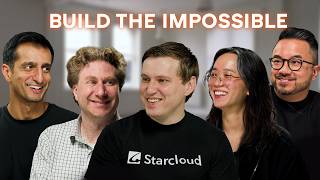
Y Combinator · 2026-08-05 · 36 min
https://www.youtube.com/watch?v=A9JDkiYEhfYVideo summary
Starcloud CEO Philip Johnston explains how an H100 reached orbit and why 88,000 satellites could host space-based AI data centers.
Starcloud co-founder and CEO Philip Johnston traces the idea to falling launch costs and a 2023 visit to SpaceX’s Starbase. After finding that space-based solar loses 95% of its power in transmission, the company pivoted to putting data centers in orbit, where Johnston estimates launch costs could break even at $500 per kilogram. Founded on January 1, 2024, Starcloud booked a SpaceX rideshare the next day. Its Starcloud-1 launched an Nvidia H100, tested AI workloads, and survived a two-week commissioning period that included troubleshooting a satellite that restarted every two hours. Johnston says the toughest engineering challenges are removing heat in a vacuum and protecting chips from radiation; Starcloud is developing lightweight radiators and testing commercial components. The planned 200-kW Starcloud-3 could enable 20 GW of compute across a proposed 88,000-satellite constellation. The company has won four government contracts and plans to serve military and satellite-imagery customers before scaling for hyperscalers as launch costs fall.
Chapters
- 0:00Book a launch first: Starcloud reserved a SpaceX rideshare on January 2, 2024
- 1:35The Starbase trip that started it: factories planned for three Starships per day
- 3:20Why space-based solar didn't work: 95% transmission loss and a $500-per-kilo data-center threshold
- 7:15First contact after 12 hours, then a restart fault that took three days to isolate
- 9:42The two hardest problems: removing heat in vacuum and protecting chips from radiation
- 11:27GPU radiation tests: 24 hours at accelerators simulates a five-year mission
- 12:49Automotive-style components instead of expensive space-grade electronics
- 14:30What 100 VCs got wrong: an H100 could run in orbit with phase-change cooling
- 18:38The path to 20 GW in space: an FCC filing for 88,000 Starcloud-3 satellites
- 21:16Designing a GPU for space with NVIDIA: Rubin chip work and a modified H100
- 24:00Why hard tech became popular with VCs after Starcloud faced 100 rejections
- 25:37Inside the Benchmark round: Chethan backed Starcloud’s engineering team
- 26:57Their hiring strategy: 20 engineers, with a six-month wait for the first hire
- 28:08How to be contrarian but right: recruit space engineers before choosing an idea
- 31:44What if data centers get banned on Earth? New York blocks construction
- 32:45Data center myth busting: water use, natural gas, and national security
- 35:09Advice for hard tech founders: build the technical team first
This is a Tier 1 public summary
Whether the chapter key points, section summaries and mind map are public is up to the person who shared it. Want the full analysis?Submit one yourself.
More from this channel
 Patrick Collison: Is AI Breaking the Lean Startup Playbook?Y CombinatorPatrick Collison says Stripe’s new-business starts are nearly 2x year over year, making this a better time than ever to found a company.
 Waymo Co-CEO Dmitri Dolgov: The Demo Is Only 1% Of The WorkY CombinatorWaymo co-CEO Dmitri Dolgov says the demo took 18 months, but building a safe robotaxi product took 15 years.
 Garry Tan: Own Your IntelligenceY CombinatorGarry Tan says personal AGI can make one founder 400x more productive—and argues your AI skills should stay in your own repo.
 Max Hodak: Average Is Not Good EnoughY CombinatorScience CEO Max Hodak says Helix and faster iteration drive startup speed, while one retinal implant patient read a 300-page novel.
 How To Design In The Agent EraY CombinatorPaper founder Stephen Haney demos agent-native design and explains why human taste—not AI-generated purple gradients—helps companies stand out.
Related analyses
 Why AI Demand Is Outrunning Compute Supplya16zGavin Baker argues AI compute demand will outpace supply, with sub-one-year infrastructure paybacks and orbital data centers approaching.
 The 5 megatrends that will dominate 2026Money & MacroJuri forecasts China’s industrial rise, debt constraints, an AI bubble surviving 2026, and a 25% chance of a Taiwan blockade.
 The RAM Crisis Keeps Getting WorseColdFusionAI data centers are tightening RAM supplies, driving up device costs as Samsung, SK Hynix, and Micron prioritize enterprise buyers.
 EP314. iPhone 要漲價了、SpaceX 如何估值、瓦基教大家用 AI | M觀點M觀點iPhone 18 恐漲至 999 美元、SpaceX 合理估值約 1.05 兆美元,瓦基則分享 AI 第二大腦的實用工作流。
 AI巨头们之间的资本混战,到底是个什么情况?小Lin说微軟持有 OpenAI 約 27% 股權,亞馬遜與 Google 轉向雙押 Anthropic,AI 投資也綁定天價算力訂單。