Blake Scholl: Why Plane Speed Stalled, Supersonic Commercial Flight, & Revolutionizing the Engine
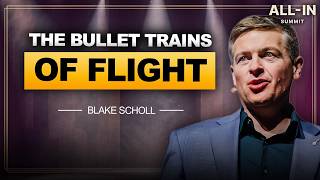
All-In Podcast · 2026-09-22 · 18 min
https://www.youtube.com/watch?v=Gnb-CfNPcPEVideo summary
Boom Supersonic targets Mach 1.7 flights while adapting its engine for 42-megawatt data centers.
Boom Supersonic CEO Blake Scholl argues that commercial aviation has stalled since Concorde, but says his 50-person team is reviving supersonic travel. The company’s XB1 became the first privately developed jet to break the sound barrier in 2025, demonstrating “boomless cruise,” which redirects the sonic boom upward. Scholl says the U.S. supersonic flight ban began ending June 6 and that related legalization legislation passed the House and Senate unanimously, with final Senate action remaining. Boom is also building its own vertically integrated engine and turbine factory after ending its Rolls-Royce partnership. The engine’s first application may be ground-based: trailer-mounted systems could deliver 42 megawatts of water-free, behind-the-meter power for data centers, with tens of gigawatts of customer demand already in Scholl’s inbox. For passengers, Boom targets Mach 1.7 Atlantic crossings in three hours, a roughly $3,500 break-even round-trip fare, and service around 2030.
Chapters
- 0:00Welcome Blake Scholl: Boom’s 50-person XB1 breaks the sound barrier
- 5:11Solving the sonic boom: Boomless cruise and unanimous legalization votes
- 7:59The pivot to powering data centers: 42 MW generators and 10+ GW planned
- 10:38Jason joins: three-hour Atlantic flights, tens of gigawatts of demand, and Boom’s long-term win
This is a Tier 1 public summary
Whether the chapter key points, section summaries and mind map are public is up to the person who shared it. Want the full analysis?Submit one yourself.
More from this channel
 Jensen Huang: The Doomer Hoax, Superintelligence is Here, and The Future of AI (ft. President Trump)All-In PodcastJensen Huang dismisses AI doomer predictions, backs open models, and says superintelligence already exists in narrow domains
 Elon Musk & Gwynne Shotwell on AI Risks and Peer Review, Starship, Terafab, SpaceX/Tesla MergerAll-In PodcastElon Musk forecasts Starship reusability in 2027 and urges AI peer review after Hugging Face security incidents.
 JD Vance on AI, Entitlement Fraud, Iran War, Israel, H-1B Abuse & the MidtermsAll-In PodcastJD Vance cites 3 million fewer illegal immigrants, $250 billion saved, and a $100,000 H-1B fee.
 Satya Nadella on the AI Doomer Slowdown, Microsoft’s Master Plan & Who Wins AIAll-In PodcastSatya Nadella defends Microsoft’s $80 billion Azure bet and AI safety, citing Quincy’s 12x tax revenue growth.
 Brad Gerstner: No AI Bubble, Semis Eat the Nasdaq & AI's Take Off ProblemAll-In PodcastBrad Gerstner says AI is no bubble, but Anthropic revenue and 43 gigawatts decide whether markets take off